











Yanagawa, a former castle town in southern Fukuoka Prefecture, joined the West Golden Route in May 2026, and Mayor Hisashi Matsunaga now sits on the alliance's board. Summer is a reasonable time to test what the town offers: until 30 September, flat-bottomed boats hung with paper lanterns run the old castle moats after dark.
A Town You Travel By Water
Yanagawa was built around its water, and not for the reason visitors usually assume. People settled here roughly 2,200 years ago on wetland. To make it habitable they dug channels, used the excavated earth to raise the ground for houses, and pushed back flooding and storm surge. The canals came first and the town followed. They also supplied irrigation and household water. According to Yanagawa City, the network totals about 930 kilometres.
The reason the digging mattered is the Ariake Sea just south of the town, which has the largest tidal range in Japan – up to six metres. At high tide the sea sits higher than the settled land. The moats are not scenery; they are the reason the place is dry. In the Edo period a feudal lord, Tanaka Yoshimasa, built a 32-kilometre embankment, the Keicho Hondoi, and reclaimed a large area of farmland behind it.
The standard way to see all this is not on foot but from a donko-bune, a shallow wooden boat poled by a boatman who narrates the route and sings as he goes. Seven or more operators run cruises, and there are two broad types: the through route, roughly an hour from near Nishitetsu Yanagawa Station down to the Okihata and Ohana area, and shorter loop cruises around Okihata itself. The through route is one-way – the boat does not return to the station – so check how you are getting back before you board. Booking is not required but is advised in busy periods.
- 60-minute course: 1,800-2,200 yen for junior-high students and above; 900-1,100 yen for children
- 30-40 minute course: 1,000-2,000 yen for junior-high students and above; 500-1,000 yen for children
- Note: Fares differ by operator
Where The Boats End Up
The through route finishes near Ohana, the villa the Tachibana family built on the southwest corner of Yanagawa Castle. Its garden, Shotoen, is a National Place of Scenic Beauty, and you view it seated, through the opened windows of the hall rather than from a path around it – which is an unusual way to be shown a Japanese garden and worth the stop on its own. On the same grounds, the Tachibana Museum holds the family's armour, tea utensils and generations of hina dolls.
Yanagawa Lantern Boats: How To Board
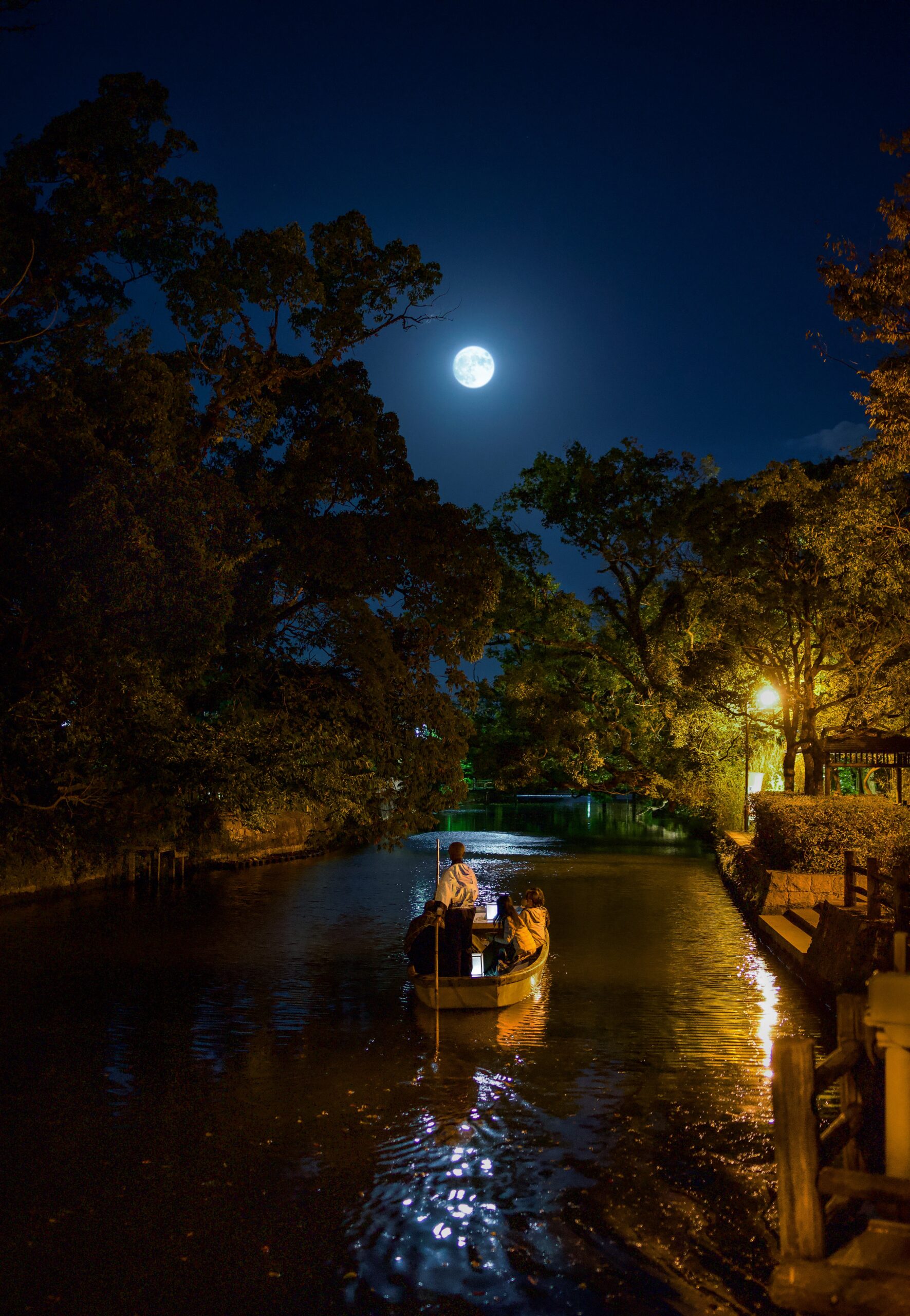
The Yanagawa Lantern Boats are in their 18th year, organised by the Yanagawa-Okawa Ryokan Association. Lanterns float on the water and light the canal-side streets while the boat works through the inner moat. Snacks and drinks may be brought aboard; full meals are permitted on private boats only, and you take your rubbish with you.
One point to get right: several operators in Yanagawa run night cruises under similar names, on different schedules and from different landings. The details below are for the Yanagawa-Okawa Ryokan Association event announced by Yanagawa City. If you book elsewhere, confirm the departure point separately.
- Dates: 17 July – 30 September 2026, 18th edition. Cancelled in bad weather
- Departure: Shared boats 19:40 sharp. Private boats between 18:30 and 20:00
- Duration: About 70 minutes
- Boarding point: Karatachi Bunjin no Ashiyu landing, 9 Yashiro-machi, Yanagawa
- Route: Inner moat, Nobori course. Ends at the landing north of Yanagawa Hakuryuso, 16 Shinmachi
- Capacity: 16 per boat
- Fares: Shared: 2,200 yen adult, 1,100 yen child aged 5 and over. Private: 22,000 yen per boat for up to 10
- Booking: By telephone, by 16:00 on the day of boarding. Reception 09:00-16:00. Advance booking accepted
- Payment: If not staying overnight, settle in advance at the Yanagawa Hakuryuso front desk. Cash or Yanagawa-han Pay only
- Cancellation: Free until 16:00 on the day. 100% thereafter
- Organiser: Yanagawa-Okawa Ryokan Association, +81 944-73-1188
What Else Is Here
Eel is the local dish, served as seiro-mushi – steamed over sauced rice in a box rather than grilled on a plate, and finished with shredded egg. The Agency for Cultural Affairs has recognised it under its 100-Year Food programme, in the category for regional dishes continuing since the Edo period, on a submission by the Yanagawa City Tourism Association. The restaurant that calls itself the originator dates the dish to 1681. Most eel restaurants stop lunch service between 14:30 and 15:00, which catches out visitors planning to eat after a late-morning cruise.
The other thing Yanagawa is known for is a poet. Kitahara Hakushu was born here in 1885 into a sake-brewing family, and his 1911 collection Omoide, written after the family brewery burned down and the household declined, made his name on the strength of his memory of this town. He wrote more than 20,000 pieces in 57 years, including children's songs still sung today. His birthplace and memorial museum are in Okihata, open 09:00-17:00 with last entry at 16:30, at 1,000 yen for adults, 600 yen for students and 400 yen for children.
Hakushu is also why the town's largest event happens in November rather than summer. The Hakushu Festival water parade, held from 1 to 3 November 2026 around the anniversary of his death on 2 November, is in its 74th year: boats move a four-kilometre course past stages of folk performance, drums and choirs, with lanterns on the water and fireworks at the end. Be aware that it is expensive and sells out – 11,000 yen per person on a shared boat, 176,000 yen for a private one, with booking from 1 July and the first evening already full for 2026.
What Joining The Alliance Means
The West Golden Route Alliance formed in May 2024 to draw Western and Australian travellers past the Tokyo -Osaka corridor, where roughly 80 per cent of them currently concentrate. It now runs to 50 municipalities and more than 330 organisations including the private sector, and is chaired by Fukuoka Mayor Soichiro Takashima. For travellers, the practical effect is that Yanagawa now appears inside a route rather than as a detour of one.
It is well placed for that. Nishitetsu runs from Nishitetsu Fukuoka (Tenjin) to Nishitetsu Yanagawa in about 49 minutes by limited express with no change, for 960 yen – and the boarding points are five minutes' walk from the station. Nishitetsu also sells a Dazaifu and Yanagawa Sightseeing Ticket combining the return rail fare, a daytime cruise and local coupons, at 3,620 yen for an adult digital ticket and 3,730 yen on paper, valid over two days. Note two restrictions: the cruise portion is valid with one operator only, and the ticket cannot be used at automatic gates – you show it to station staff.
Sources: Yanagawa City, Yanagawa City Tourism Association, Yanagawa-Okawa Ryokan Association, Kitahara Hakushu Birthplace Memorial Foundation, Nishi-Nippon Railroad #WestGoldenRoute #Yanagawa #Fukuoka #Nukumori