










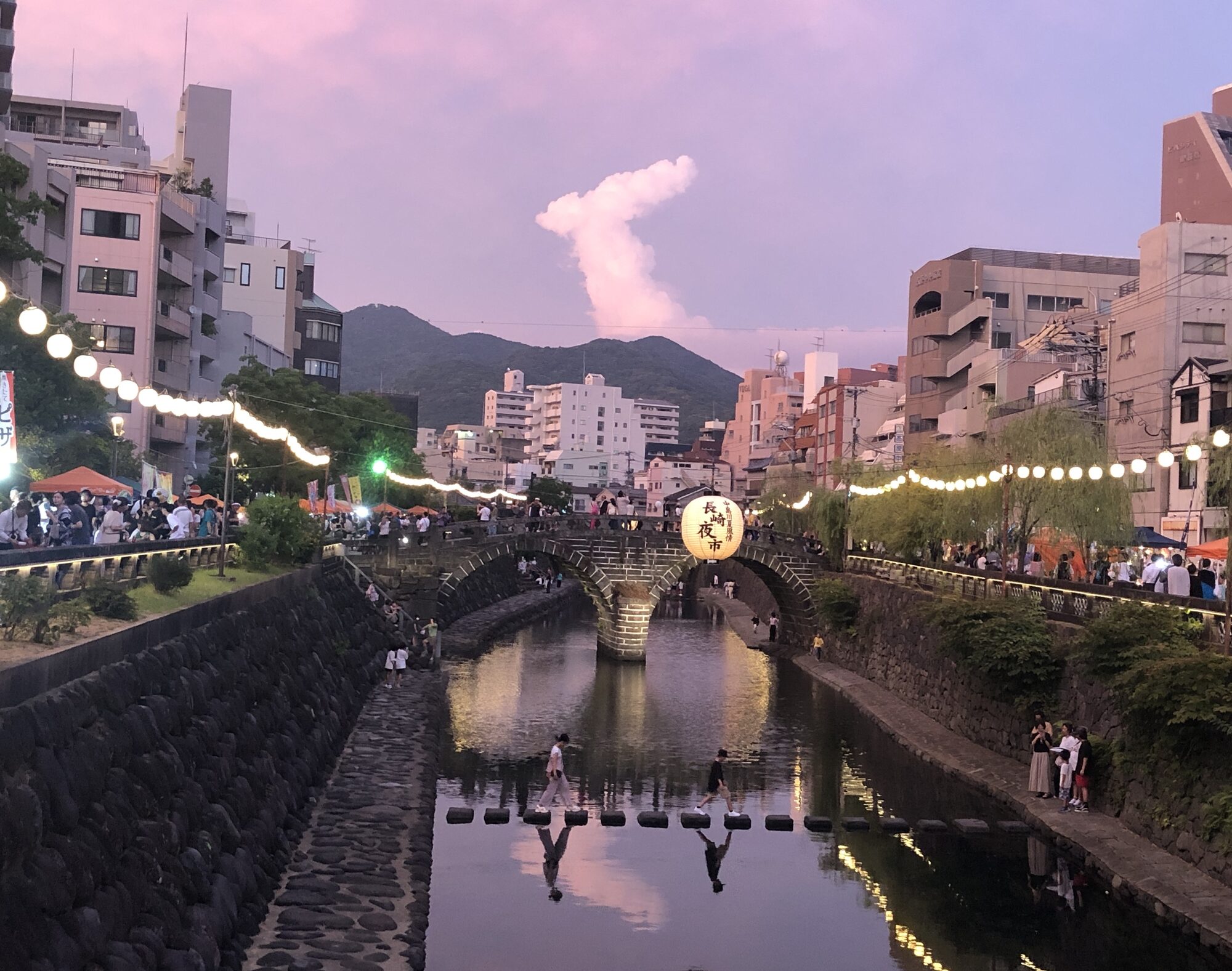
On four nights in August 2026 – the 1st, 2nd, 22nd and 23rd – both banks of the Nakashima River in central Nagasaki turn into a night market. Around 200 paper lanterns are strung along the water, the stone bridges are lit, and people move slowly between the food stalls and the stage. Yukata are common. In a city with a heavy calendar of summer events, this is the least hurried of them.
What Makes It Worth Seeing
The setting does most of the work. The Nakashima River is lined with Edo-period stone arch bridges, and the best known of them is Meganebashi – Spectacles Bridge – built in 1634 and generally held to be the oldest stone arch bridge in Japan. Its two arches reflect in the still water to form two complete circles, which is where the name comes from. Standing under two hundred lanterns, watching the stonework lit from below and doubled in the river, you are looking at the thing the whole event is arranged around.
Meganebashi has a harder history than its reflection suggests. It partially collapsed in the Nagasaki flood of 1 982, was rebuilt the following year, and is now a nationally designated Important Cultural Property. It is counted among Japan's three most celebrated bridges, alongside Nihonbashi in Tokyo and Kintaikyo in Yamaguchi. Set into the embankment nearby are heart-shaped stones, which the city has quietly let become a spot for couples.
The food is straightforward festival food, and that is the point. You will find yakisoba and other festival staples, shaved ice, and cold beer. Nobody is trying to make an occasion of it.
Unlike the larger events on this city's calendar, the night market asks nothing of a visitor. There is no parade you have to be in position for, no seat to secure, no timetable to work around. You arrive when the light goes, walk along the bank, eat, and leave when the lanterns have done their turn around the middle of the evening. For a traveller who has just come off a long rail journey, that shape suits better than most things.
Why The Bridges Are Here At All
A row of Edo-period stone arch bridges in a Japanese city is not normal. Japan built in wood; stone arch construction came in from China, and it came in here because this was the one place it could. Chinese residents and the temples they founded brought the technique, and the merchants along the Nakashima River had the money to commission it. What survives is a stretch of river with more than a dozen stone bridges, each built by a different backer, none of them quite matching. Walking the bank from one to the next is a compressed les son in who this city traded with and how well it did out of it.
Timing Your Evening
Come at dusk rather than after dark. The reflection that gives Meganebashi its name needs two things – light under the arches and a still surface – and both are best in the half hour when the sky still has color in it and the wind has dropped. Later in the evening the water picks up ripples from the crowd on the banks and the circles break up. If you want the photograph, arrive early and take it first; the stalls will still be there afterwards.
The riverbank is worth the walk on any evening. The Nakashima River Park runs along the restored embankment with a footpath at water level, and the landscape lighting on the bridges stays on until 22:00 year round. The night market simply concentrates what is already there into four evenings and adds two hundred lanterns to it. If your dates do not line up, you have not missed the place – only the crowd.
How To Attend
Free to enter; you pay at each stall. The site runs along both banks of the Nakashima River around Meganebashi, about fifteen minutes on foot end to end. There is no route to follow. Stage events run through the evening. The event is listed by the city under its full name, Nakashima-gawa Natsu Fuzei – Nagasaki Yoichi, which translates roughly as the summer mood of the Nakashima River.
- Dates: 1, 2, 22 and 23 August 2026
- Venue: Both banks of the Nakashima River, around Meganebashi and the stone bridge group
Highlights About 200 lanterns, the stone bridges lit, food stalls, stage events
- Admission: Free. Food and goods are paid for at each stall
- Official Info: at-nagasaki.jp/event/52060
Getting There
Nagasaki is the terminus of the Nishi-Kyushu Shinkansen, connected towards Hakata via Takeo-Onsen. From Nagasaki Station the tram runs to Meganebashi in about ten minutes, at a flat fare and every few minutes. Th e stone bridge district sits in the middle of the city, so it drops neatly into the end of a day spent tracing the tr ading history of the place.
For more on what to see and do in Nagasaki, visit the official Nagasaki tourism website.
Source: Nagasaki City #WestGoldenRoute #Nagasaki #Meganebashi #Nukumori Photo: Nagasaki City