










Every 15 August, families in Nagasaki who have lost a member since the previous Obon pull a hand-built boat through the city. The rite is called Shoro Nagashi, and its purpose is to send the spirit of the dead onward to the Pure Land. Visitors are welcome to watch. What you should know first is that this is a mourning observance conducted in public, not a spectacle arranged for an audience.
What You Are Looking At
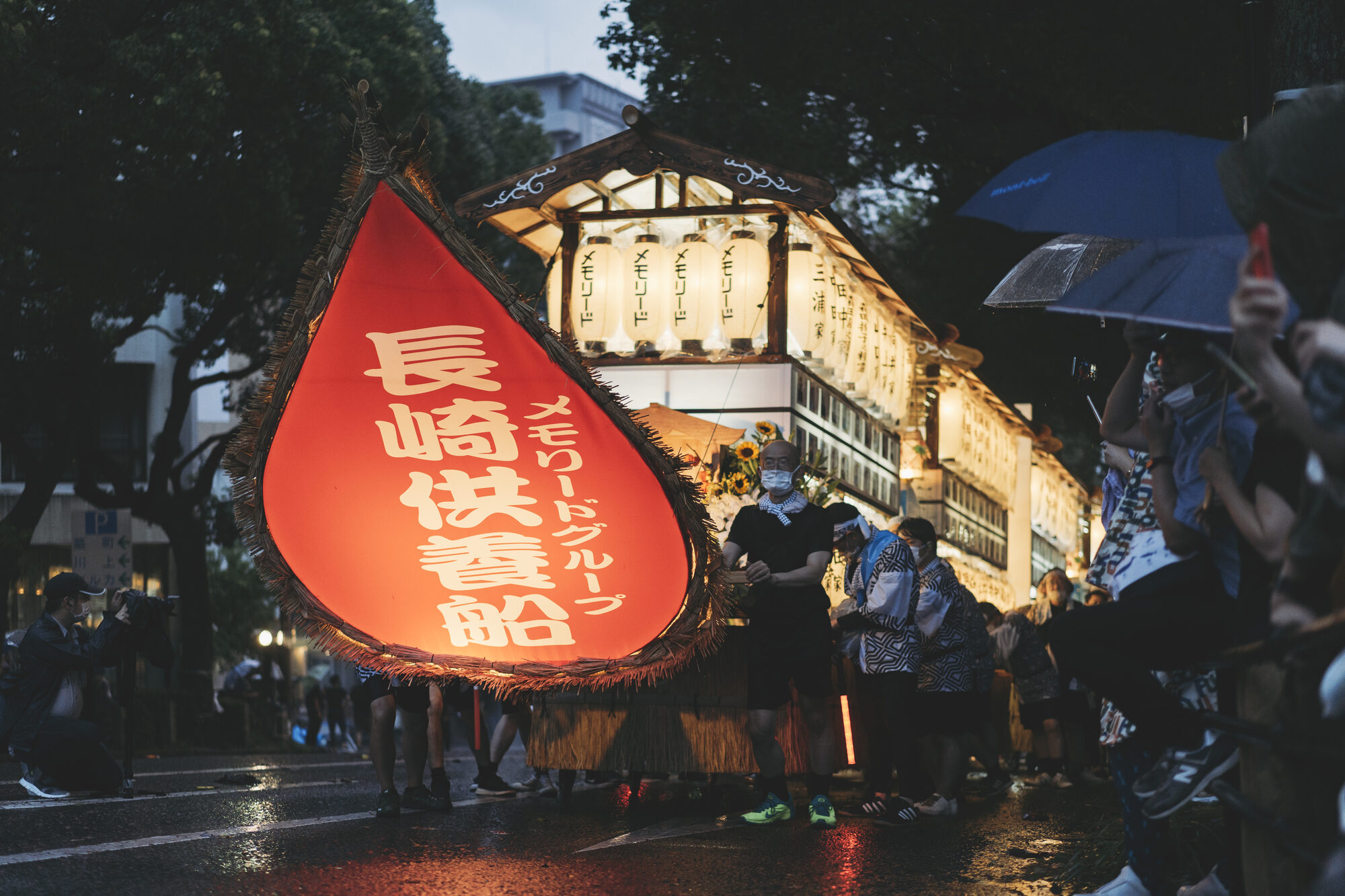
The boats are built by each household over several weeks, mainly from bamboo, board and straw. They range from small ones carried by a few people to structures several metres long. The long projecting prow, the miyoshi, carries the family crest, the family name and the name of the district in large characters. Decorations reflect the interests and the working life of the person who died, and the places they loved. From the start of August, half-finished boats begin to appear on the streets. That in itself is part of Nagasaki's quiet summer landscape.
On the day, the sound reaches you before the boats do. A bell keeps the rhythm – chan-kon chan-kon – and the pullers call out do-i do-i. Then the firecrackers start. In this observance, firecrackers derived from Chinese practice through the city's trading history are used in enormous quantity, set off continuously to purify the road the spirits travel. The procession continues late into the night.
One practical warning. The firecrackers are extremely loud – close up, loud enough to hurt. The streets fill with smoke and paper. Bring ear protection; it is a reasonable precaution. With small children, watch from further back. Watch quietly, and give way to the families pulling the boats. They are in the middle of sending some one off.
How To Watch Without Intruding
There is no rope line and no marshal telling you where to stand, which puts the responsibility on the visitor. A few things hold. Stand back from the road and leave the centre clear – the boats are heavy, the crews are tired, and they cannot steer around you. Do not walk alongside a boat to keep filming it. Photograph the boats and the crowd freely; think twice before photographing a face, because the people at the front are the family. I f a procession stops, it has usually stopped for a reason connected to the person being sent off, not for a photo opportunity.
None of this requires solemnity. The streets are loud, people drink, children run about, and the families them selves are often laughing. Japanese mourning at this scale is not silent. But the licence to enjoy it comes with the obligation not to get in the way of it, and that distinction is easy to hold once you know it exists.
Where It Sits In The Nagasaki Calendar
Obon in mid-August is observed across Japan as the period when the dead return to their families, and it usually closes with something quiet – a lantern set on a river, a fire lit at a gate. Nagasaki does it with firecrackers and a boat the size of a car. The contrast is the point of interest, and it comes from the same trading history t hat shaped everything else in this city.
Six days earlier, on 9 August, the city holds Manto Nagashi on the same water: lanterns made by local primary schools and neighbourhood associations, assembled into a frame on the river and towed by boat, in memory of those who died in the atomic bombing. Two observances, six days apart, on the same rivers, for different dead. A visitor in Nagasaki during the second week of August will encounter both, and the city does not separate them for convenience.
Getting Around On The Day
Do not plan to drive on 15 August. Nagasaki Police close roads across the city from 17:00 until the procession ends, and the closures are extensive rather than a single cordoned street. Car parks inside the restricted zone, and car parks on roads leading into it, may be unable to let vehicles in or out for the duration – so a car left in the wrong place is a car you cannot collect until late at night.
The closure map changes from year to year and is published by Nagasaki Prefectural Police ahead of the date, in three sheets covering the city centre, the Inasa district and Higashi-Nagasaki. Check it before you travel. T rams and walking are the sensible way to move that evening; if you are staying outside the centre, work out y our route home before the procession starts rather than after. Enquiries: Nagasaki Police Station, Traffic Regulation Section, 095-822-0110.
How To Attend
Free to watch from the roadside. There are no tickets, no seating and no official viewing area. The procession moves through the public streets of central Nagasaki from around dusk. Please extend the same consideration you would at a funeral: do not obstruct the boats, and use your judgement about photographing the bereaved.
- Date: 15 August 2026, from around dusk into the night
Nature of the event A mourning rite for those who lost a family member in the past year
Place Public streets of central Nagasaki
- Admission: Free to watch
Caution Firecrackers are set off continuously and are extremely loud. Ear protection recommended
Road closures From 17:00 until the procession ends, across the city. Maps published by Nagasaki Prefectural Police
Getting around Tram and on foot. Do not drive
- Official Info: at-nagasaki.jp/event/51798
Closure maps police.pref.nagasaki.jp/police/nagasaki/syourounagasi-kisei/
Getting There
Nagasaki is the terminus of the Nishi-Kyushu Shinkansen, connected towards Hakata via Takeo-Onsen. The procession moves through the centre, all of it within tram reach of Nagasaki Station. For anyone travelling in western Japan over the Obon period, it is worth saying plainly that 15 August in Nagasaki is unlike 15 August anywhere else in the country.
For more on what to see and do in Nagasaki, visit the official Nagasaki tourism website.
Source: Nagasaki City #WestGoldenRoute #Nagasaki #ShoroNagashi #Nukumori Photo: Nagasaki City