









 #Nagasaki City

Every 9 August, Nagasaki holds the Nagasaki Peace Memorial Ceremony in front of the Peace Statue in Peace Park, Matsuyama-machi. Bereaved families and a large number of residents attend, mourning those killed by the atomic bomb in 1945 and praying for lasting world peace. Attendance by visitors requires advance registration, and for 2026 registration has already closed. If you are in Nagasaki on the day without a place, you can still mark it – the sites around the park are open, and the city observes the moment wherever you are standing.
What The Day Means Here
At 11:02 on the morning of 9 August 1945, the second atomic bomb used in war detonated above this place. The ceremony is held at that site, at that hour, and the names of those who died in the past year are recorded. For Nagasaki this is not distant history. Survivors still attend. The city has built much of its post-war civic identity on a single proposition: that what happened here must not happen anywhere again.
The centre of the ceremony is the Peace Declaration, read by the Mayor of Nagasaki. It is translated into ten languages and transmitted worldwide over the internet. Its content is consistent – a call for the abolition of nuclear weapons and the establishment of lasting world peace. Nagasaki has repeated that call every year for more than eighty years, and the declaration is watched internationally as a statement of the city’s position.
The Rest Of The Day, And The Day Before
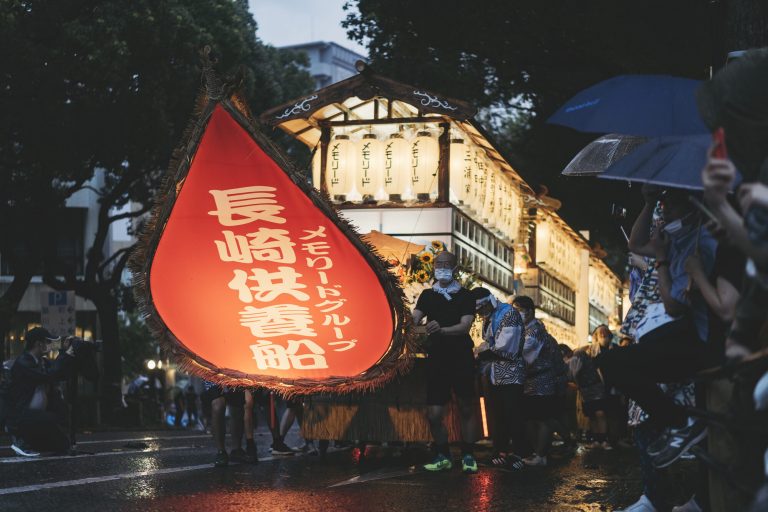
The 9th is not a single ceremony but a full day of observances, most of which need no registration. In the evening, Manto Nagashi sets lanterns made by local primary schools and neighbourhood associations onto the river in a wooden frame, towed by boat, in memory of the dead. A torchlight procession of around a thousand people walks the roughly 800 metres from Peace Park to Urakami Cathedral, carrying with them the Hibaku Maria – the statue of the Virgin damaged in the bombing. The day before, on 8 August, a separate memorial service is held for the victims.
For a traveller in western Japan in early August, the morning of the 9th is worth giving a day to rather than fitting between other plans. The Atomic Bomb Museum, the hypocentre marker and the National Peace Memorial Hall for the Atomic Bomb Victims all stand in the same district and give the ceremony its context. Most people who come find that one site leads to the next and the afternoon goes.
The Three Sites Around The Park
Three places stand within a few minutes of each other, and the order you take them in matters. The Nagasaki Atomic Bomb Museum gives the sequence of events and the physical evidence. The hypocentre marker, a plain black column in a small park, marks the point directly below the detonation – there is nothing to read there, which is the effect. The National Peace Memorial Hall for the Atomic Bomb Victims is a place of remembrance rather than exhibition, holding the register of the dead. Most visitors find the museum first and the memorial hall last is the order that works.
None of this requires the 9th. The sites are open year round and are quieter on any other day. If your itinerary through western Japan does not fall on the anniversary, you have not missed Nagasaki – the ceremony is one morning, and the reason for it is here every day.
If You Attend
The venue is in front of the Peace Statue in Peace Park, Matsuyama-machi, and advance registration is required. Attend quietly, dress modestly, and follow the instructions of staff on site. Think carefully before photographing during the ceremony, out of consideration for the bereaved families present.
- Date: 9 August 2026
- Venue: In front of the Peace Statue, Peace Park, Matsuyama-machi, Nagasaki
- Attendance: Advance registration required. Registration for 2026 has closed
- Purpose: To mourn the victims of the atomic bombing and to pray for lasting world peace
- Peace Declaration: Read by the Mayor of Nagasaki. Translated into ten languages and transmitted worldwide
- Also on 9 August: Manto Nagashi (lantern float); torchlight procession from Peace Park to Urakami Cathedral
- Nearby: Nagasaki Atomic Bomb Museum; the hypocentre; National Peace Memorial Hall for the Atomic Bomb Victims
- Official Info: at-nagasaki.jp/event/50862
Planning For A Future Year
If you want to attend, the constraint is registration, not travel. The city opens applications in June – usually somewhere between the first and the last part of the month, though the dates are not fixed year to year – and closes them well before August. Applications are accepted through the city website and by postcard. If you are applying from outside Japan, allow for the post; the online route is the practical one.
In practice this means checking the city website from around May of the year you intend to go. Waiting until July is too late. It is an unusual thing to have to book months ahead for, and it catches visitors out – which is the reason for saying it plainly here.
Getting There
Nagasaki is the terminus of the Nishi-Kyushu Shinkansen, connected towards Hakata via Takeo-Onsen. Peace Park is about fifteen minutes from Nagasaki Station by tram, alighting at Matsuyama-machi. The museum and the hypocentre are within walking distance of the same stop. Expect crowding around the park on the morning of the 9th.
Source: Nagasaki City #WestGoldenRoute #Nagasaki #Peace #Nukumori